
You are on eastlansinginfo.org, ELi's old domain, which is now an archive of news (as of early April, 2020). If you are looking for the latest news, go to eastlansinginfo.news and update your bookmarks accordingly!
You are on eastlansinginfo.org, ELi's old domain, which is now an archive of news (as of early April, 2020). If you are looking for the latest news, go to eastlansinginfo.news and update your bookmarks accordingly!

The image above is a solargraph from Wikicommons. As that site explains, this is “a solargraph taken from the Atacama Pathfinder Experiment at the Llano de Chajnantor Observatory in the southern hemisphere. This is a long-exposure photograph, with the image exposed for six months in a direction facing east of north, from mid-December 2009 until the southern winter solstice in June 2010. The sun's path each day can be seen from right to left in this image across the sky; the path of the following day runs slightly lower, until the day of the winter solstice, whose path is the lowest one in the image.”
Area residents have been enjoying longer days and the sun’s progressively higher path in the sky since the winter solstice of December 21, 2014. That is all going to come to a nearly imperceptible end when the summer solstice comes to East Lansing at 12:38 pm on June 21, 2015.
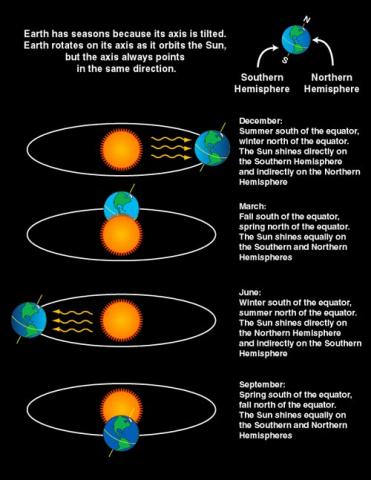
It is well known to ELi on Earth readers that the changes in length of daytime and nighttime with the progression of the seasons is due to the tilt of the earth’s axis rotation. The earth spins on an axis that passes between the north and south poles, but that axis is tipped about 23.5 degrees from the plane of the earth’s orbit around the sun.
The 23.5-degree axis tip does not change in angle or direction as the earth orbits the sun. During East Lansing’s summer, the northern hemisphere tilts toward the sun. But half a year later, when the earth has rotated half-way around to the other side of the sun, the northern hemisphere tilts away from the sun marking East Lansing’s winter. The image below, from the National Oceanic and Atmospheric Administration, shows how the tilt of the earth is maintained throughout the orbit of the earth. (Article continues after graphic.)
There are two main historically observable markers of the winter and summer solstices: (1) where on the horizon the sun rises and sets, and (2) how high the sun climbs in the sky during the day. (In modern times we can use time as well, but good clocks are a relatively recent invention.)
Where on the horizon the sun rises and sets
The sunrise and sunset on the March (vernal) and September (autumnal) equinoxes are quite nearly in the due east and the due west across the world. (The earth is a not quite round, so in the polar areas the sunrise and sunset are not quite due east and west.) From the March equinox to the June solstice (summer here in East Lansing) both the sunrise and sunset are progressively more in the north each day. The sunrise and sunset move back south again from the June solstice until the December solstice.
For those of us in the northern hemisphere, the spring and summer sun rises in the northeast and sets in the northwest in between the spring (vernal) and fall (autumnal) equinoxes. Ancient peoples left much evidence that they kept track of where the sun rose and set. Structures like Newgrange in Ireland and the Sun Dagger in the Four Corners area of the U.S. demonstrate the precision and sophistication people have long invested in tracking the position of the sun through the seasons.
Height of the sun in the sky
Sailors have long used the height of the sun in the sky to calculate how far north or south of the equator (latitude) they were sailing during the day. They used the stars for the same purpose at night. To use the sun’s height in the sky to find latitude, a sailor had to know where the sun should be in the sky for that day of the year. In recent times, star charts and tables were very precise, but the astrolabe is an ancient device navigators used for this purpose.
Each day the sun moves a little bit compared to the day before. It is relatively easy to see this if you have good view of a horizon with landmarks. Near the solstice, the sun’s position changes less and less each day, which is why it is called a solstice. Solstice comes from the Latin words sol for sun and sistere, which means to stop.
Finding the precise time of the solstice, when the sun’s position really does stop, is not possible from unaided, direct observation because the sun’s position changes so little close to the solstice. Ancient peoples probably determined the solstice the way modern amateurs do. Observers track the number of days between the time the sun was at an easily defined position before the solstice and when it returned to that position after the solstice. By dividing those days by two and adding to the date of the measurement, people could calculate the solstice to within about half a day.
For the modern residents of East Lansing, the summer solstice is a good time to wonder at the structure of the solar system, enjoy some warm days, and go a jazz festival.
eastlansinginfo.org © 2013-2020 East Lansing Info