
You are on eastlansinginfo.org, ELi's old domain, which is now an archive of news (as of early April, 2020). If you are looking for the latest news, go to eastlansinginfo.news and update your bookmarks accordingly!
You are on eastlansinginfo.org, ELi's old domain, which is now an archive of news (as of early April, 2020). If you are looking for the latest news, go to eastlansinginfo.news and update your bookmarks accordingly!
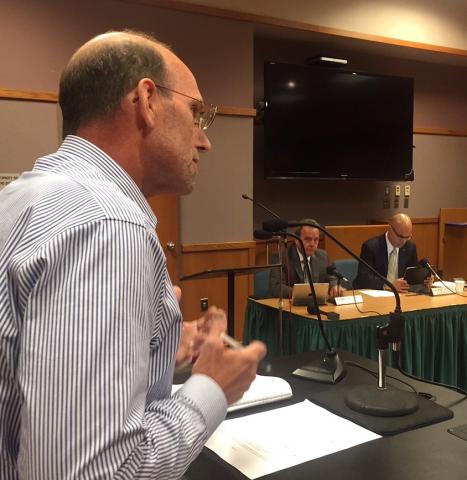
Image: Patrick Rose (left) speaking to Council last week with City Attorney Tom Yeadon (middle) and City Manager George Lahanas in the background.
Can’t the East Lansing Police Department (ELPD) legally order drunk people off unsafe roofs without City Council passing a special ordinance saying so? That is but one of the many questions that are being raised by local attorney Patrick Rose in his communications to Council on this matter.
Rose, a longtime resident of the Glencairn neighborhood, spoke at length last week at Council during the Public Hearing on would-be Ordinance 1351, an ordinance “to prohibit the use of roofs as recreational areas unless designed and constructed as such.”
Asked to explain his relevant professional expertise, Rose told me he is “an appellate lawyer and litigator who has defended police departments and advised cities about zoning ordinances, represented persons who fell off roofs and . . . represented builders and property owners in claims that zoning regulations are too broad and violate their rights. I have been an attorney for 25 years, had my own law firm for 22 years and clerked at the Michigan Supreme Court, a federal appeals court in Philadelphia and at the Delaware Attorney General's appellate division.”
Rose has raised multiple objections to the drafted ordinance, as well as to City Attorney Tom Yeadon’s handling of it. Rose has suggested the ordinance is unnecessary, that as drafted it is potentially unconstitutional, that it could cost the taxpayers tens of thousands of dollars because it is badly written, and that it could actually make rooftop partiers less safe by creating panic about getting charged once police show up.
Before Rose spoke at Council last week, City Manager George Lahanas told Council he saw the whole business as “rather straightforward.” He said the draft ordinance—which he later confirmed for me originated with his office, and apparently not with a Council member nor with the Police—is meant to stop unsafe gatherings on roofs that involve partying, gaming, and alcohol. Lahanas told Council that “at least several times of year” in East Lansing we “see serious injuries from falls” from roofs.
Lahanas named two instances involving emergency transport to Sparrow Hospital in the last year. But Rose objected to Lahanas’ use, at Council and in the media, of these two anecdotal cases to justify the alleged need for this new ordinance. Rose said that one case involved a person publicly intoxicated on a roof—a person who could have been arrested as a “disorderly person.” Rose told Council, “You don’t need this ordinance to take care of that problem.”
Rose said the other fall involved an individual who was on the roof to try to deal with squirrels that were getting into the house. The man fell by accident and hit his car and then hit the pavement. Rose noted the ordinance as drafted—which would allow being on the roof for maintenance purposes like plugging animal-attracting holes—would not have applied to this case, and so could not have prevented this man’s injuries.
Rose also challenged City staff’s representations of injurious roof collapses in other locales, and insisted the police (here and elsewhere) already have the legal authority to order off the rooftop partiers who were endangering themselves or others. Later questioned by Council, City Attorney Tom Yeadon seemed to suggest that local police do not have an enforceable way currently to order partygoers off roofs. He said there was too much subjectivity now, and the police needed a specific ordinance to back them up. (See Yeadon’s memo on the ordinance.)
But Rose said he had informally polled some local prosecutors and those with whom he spoke thought a prosecutor could legally back a police officer who ordered a partier off a roof to keep the partier or others safe. According to Rose, he himself has twice had to call ELPD to deal with partygoers on roofs endangering themselves or others, and he says that, in both instances, ELPD was able to safely get people off the roofs.
Rose’s concerns about the constitutionality of the law relate to whether the ordinance would unjustly limit a person’s use of private property. This ordinance as drafted would, for example, mark as breaking the law a homeowner who went out on her own flat roof to sunbathe, even if she remained ten feet from the edge and even if the roof were only six feet off the ground. The ordinance might also mark as breaking the law a homeowner who went out on his roof to hang an American flag on July 4, because hanging a flag would perhaps not count as “maintenance.”
According to Rose, “One can be safe to go up on a roof to get a Frisbee caught on the roof, to rescue a cat or to sunbathe on a low, flat roof. . . . Such use or occupancy, moreover, is an aspect of the homeowner’s property right. A City cannot take the use of that roof for that purpose without valid justification. The ordinance [as drafted] is so broad that it exceeds the City’s valid right to regulate all uses of a roof by banning recreational activities that do not occur in an area barricaded by a handrail.”
Rose has suggested to Council that the City is going to end up having to defend this ordinance in court—which, Rose notes, would involve paying City Attorney Tom Yeadon to do so. Yeadon is an external attorney contracted for work and paid by the hour, so the more the City has to go to court, the more he is paid. Last year, the City paid about $460,000 in legal bills to Yeadon and his associates. This year it is projecting a cost over a half-million dollars. (There has been a grassroots movement to shift to an in-house attorney which some say would save costs.)
Rose told me, “The deeper problem I have is how Council defers to a City Attorney who has a monetary incentive to give advice about an ordinance, downplaying concerns about defects in it. When this same City Attorney, who is in a private law firm, will profit from his own incomplete or bad legal advice on how to narrowly tailor the ordinance, he can leave thinking about any problems with how the ordinance is drafted for when he is being paid tens of thousands of dollars to defend the lawsuits filed against the City due to his own incomplete legal advice. This has happened on many occasions with many ordinances regulating homeowners’ use of their property.”
Rose wants to see “an outside lawyer without a built in conflict [of interest] be paid the same amount to give advice on how to revise this ordinance. I advocate that approach so that the taxpayers of East Lansing pay less to get the job done right by drafting the language tightly.” He said he wanted a legally “bulletproof” ordinance so taxpayers would not have to pay to defend a poorly written ordinance in court.
During discussion, Councilmembers did not take up this monetary issue raised by Rose. They did, however, discuss wanting to ensure that the punishment not be set so high that partygoers panic and further endanger themselves when caught by police (a concern Rose also raised) and that people be “educated” about the ordinance before it really goes into effect.
Council also discussed landlords’ wish not to have violations ultimately accrue to them. During public comment, landlord Matt Hagan echoed the written remarks submitted by landlord Jeff Hudgins, who said, “we think both for safety and to stop potential roof damage, we definitely do not want recreational usage of roofs.” But, in Hudgins’ words, “We would like to see the language in the ordinance changed to not penalize the property [owners]. . . . Rental property owner[s] should not be ticketed for an act totally out of their control after making it known in the lease and at access points to the roof that we prohibit such use.” (For full text, see page 12 here.)
On this point, Councilmember Susan Woods asked to have the landlords’ wish heeded. (As we previously reported, Woods’ campaign received substantial support from landlords, including Hagan and Hudgins, particularly when compared to others’ campaigns.) Councilmember Kathy Boyle agreed with Woods on this point. But Councilmember Ruth Beier argued that because other ordinance violations (noise; party litter) count against landlords’ licenses, so should this one if the ordinance is passed.
Mayor Pro Tem Diane Goddeeris seemed generally in favor of the ordinance but wanted it tighter and more defensible in court. She said she wanted more legal review. Councilmember Kathy Boyle and Mayor Nathan Triplett also seemed generally in favor of having some version of this ordinance, saying they saw the matter as a legitimate public safety issue. Triplett said he appreciated Rose’s “zealous advocacy” but that his arguments could lead to “oversimplification.”
Ultimately Council deferred the matter for further consideration at a later meeting, in spite of City Attorney Yeadon insisting he was “comfortable” with the ordinance as written being defensible in court. City Manager Lahanas told Council he had garnered support from his Police and Fire chiefs and his building official. To this, Beier responded that if you ask a police officer if they want a new law, they rarely say “no.”
Scott Hirko, an East Lansing resident, also wrote to Council to weigh in on this matter. (For full text, see pages 19-20 here.) He said he couldn’t be at the meeting in person because “I will be in Memphis sitting up on a roof with a beer.” He called the proposed ordinance “a waste of time, money, and any other resources I could dream of. . . . one wonders if the city manager and staff have too much time on their hands, and that the police department needs something to do.” Hirko expressed frustration with over-regulation for safety’s sake: “I get hurt playing basketball – are you going to outlaw that?” He “beg[ged] the city to not be fascist.”
UPDATE, August 12, 12:15 pm: Rose also asked us to clarify his position: "I would support an ordinance stating it is illegal to go up on the roof if it creates a danger to oneself so long as it is narrowly drafted (e.g. by defining danger as more than one person every 4 X 5 feet and confirming the police officer's right to order partiers down whose presence on a roof is creating a public nuisance). The ordinance stating when it is illegal would create an extra deterrent that would be helpful. My objection, in a nutshell, is an overly broad ordinance creates more problems than it solves."
Also, at Rose's request, the line "But Rose said he had informally polled local prosecutors and all thought..." was changed to "But Rose said he had informally polled some local prosecutors and those with whom he spoke thought..." so that it did not imply Rose had spoken to all local prosecutors.
Reminder: You can communicate with Council in person at its meetings or write to Council directly at council@cityofeastlansing.com. You can speak or write on any issue involving the City, not only what is on the published agenda.
eastlansinginfo.org © 2013-2020 East Lansing Info