
You are on eastlansinginfo.org, ELi's old domain, which is now an archive of news (as of early April, 2020). If you are looking for the latest news, go to eastlansinginfo.news and update your bookmarks accordingly!
You are on eastlansinginfo.org, ELi's old domain, which is now an archive of news (as of early April, 2020). If you are looking for the latest news, go to eastlansinginfo.news and update your bookmarks accordingly!
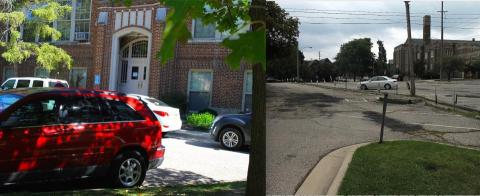
Image: The Bailey School building (left) and a parking lot (right), two of many City-owned properties that could be impacted by the land sale Charter amendment.
At a meeting held at the East Lansing Public Library last Thursday, the local organization East Lansing Citizens Concerned declared its opposition to the East Lansing Charter amendment on land sales set to be voted on May 5. If a majority of voters vote in favor of the amendment, the City Charter will be changed so that public lands over a certain value can be sold if a simple majority of voters (50% + one voter) approve the sale. Right now, the Charter requires a 2/3 supermajority (60%) voter-approval for land sales.
This marks the first time East Lansing Citizens concerned (ELCC) has taken a position on a ballot question, and it is likely to be a controversial one. The Thursday meeting attracted approximately 30 people, and opened with presentations from ELCC members Mark Sullivan, Ralph Monsma and Ray Vlasin.
Sullivan and Monsma indicated their intention to vote against the ballot proposal while Vlasin stated that he was undecided, seeing his presentation as “providing a framework for thinking about the issue.”
When the meeting turned to public comment, ten of the twelve speakers clearly supported ELCC’s stance against the ballot proposal. The other two did not support the proposal, but asked questions about what the City could do better in the development process, and about why ELCC had chosen to oppose the change to the land sale threshold.
To learn more about the reasoning of those for and against the charter amendment, for this article we talked to Mark Sullivan, Co-Chair (with Chris Root) of ELCC. We also talked to Mayor Pro Tem Diane Goddeeris and Councilwoman Kathleen Boyle, both of whom supported putting the Charter amendment to the voters.
According to Sullivan, ELCC decided to take a stand on the ballot question because, in their view, “Since the ballot issue addresses a change of procedure that affects the degree of citizen input, we decided we needed to speak out in favor of the option that encourages broader citizen participation.”
Confused about how changing the approval threshold would “encourage broader citizen participation,” we asked Sullivan why a simple majority threshold isn’t more democratic, given that it treats “yes” and “no” votes as if they have equal weight.
According to Sullivan, “Neither 50 or 60 percent is more democratic. The margin of vote required for a decision depends on the decisions of citizens. A simply majority works well for working decisions, especially those of short-term impact. A higher level of consensus, or supermajority, works well to protect highly valuable assets.”
Sullivan notes that, “For decades, our City Charter has required a 60% super-majority vote for the sale of city-owned real property. We think this is still a good idea. This is not an impossible standard. Since 2002, City voters have approved three land sales by more than the 60% margin.” (See ELi’s report on those three land sale votes, as well as on four more recent non-approved sales, all of which would have passed had there been a simple majority threshold for voter approval.)
We asked Mayor Pro Tem Diane Goddeeris for her view on this issue because we took her position, from her statements at Council, to be in support of the Charter amendment.
Says Goddeeris, “I have heard that Citizens Concerned want to keep the supermajority vote on decisions regarding land sales because it is an important decision that affects the community. There are instances where requiring a supermajority makes sense, such as the legislature over-riding a veto by the governor, but even amending the state constitution—which is obviously a very serious matter—requires only a majority vote of the people.”
Goddeeris adds, “I don’t see a good reason why a supermajority should be required for the sale of property. We are clearly out of step with most other communities in Michigan on this issue. The supermajority requirement has sometimes tied the hands of city council in direct opposition to the will expressed by a strong majority of voters.”
Goddeeris notes that a simple majority is not all that is required to sell a public property: “even with dropping the supermajority requirement there are still two hurdles to be crossed before property will be sold. One is getting a majority of the [East Lansing city] council, who are elected by the voters, and the second is getting a majority of the voters themselves.”
We asked the same question of Councilwoman Kathleen Boyle, who replied that she “voted for and support the charter amendment regarding the sale of city property, because it makes sense to me. The 3/5 voter approval that the City Charter currently requires is a vestige from a prior version of the Home Rule Cities Act, and it is a requirement that Act abandoned back in the 1960s.”
Boyle adds that “the proposed amendment will continue the requirement for voter approval of the sale of public land that exceeds $4.00 per capita in value, but it will allow for the adjustment of that value, tied to changes in the consumer price index. This makes sense to me. The amendment will lower the threshold for approval from a super majority of 3/5 of those voting to a simple majority.”
Boyle concludes, “Majority rule is a lodestar of democracy, and the decision by a simple majority of those voting is entirely appropriate.”
In a related issue that is becoming part of the pro/con dialogue about the Charter amendment, East Lansing’s City Charter as written says that a 60% voter approval is necessary for the sale of park land, but as ELi has reported, in fact only a 50% + one vote approval is currently needed to sell park lands. Earlier this year City officials sent up the ballot language on this possible amendment to the State as required, and it was then that City officials learned from the Michigan Attorney General that because of a legislative change in 1966, park land in East Lansing can be sold with a simple majority vote (50% + one voter), something City officials now realize has been true for the last 50 years.
The strange effect of this situation is that if this charter amendment does not pass, public park land can be sold with only a simple majority voter approval, while the sold of other lands – say, for example, parking lots – would require a supermajority voter approval.
Asked about this, ELCC’s Sullivan says, “It is true [that if this Charter amendment fails to pass] there would be an inconsistency in the weight used for the sale of property and the sale of parks.” But, he says, “The solution is not to make it easier to sell non-park land. The solution would be to find a way to protect the sales of parks from the kinds of opportunistic sales other kinds of public lands are protected from.”
This Tuesday at City Council, City Manager George Lahanas named this discrepancy—a simple majority threshold for the sale of park lands with a supermajority threshold for the sale of non-park lands—as a reason citizens should vote in favor of the Charter amendment.
Changing the East Lansing City Charter requires only a simple majority (50% + one vote) approval of the proposed Charter Amendment.
eastlansinginfo.org © 2013-2020 East Lansing Info