
You are on eastlansinginfo.org, ELi's old domain, which is now an archive of news (as of early April, 2020). If you are looking for the latest news, go to eastlansinginfo.news and update your bookmarks accordingly!
You are on eastlansinginfo.org, ELi's old domain, which is now an archive of news (as of early April, 2020). If you are looking for the latest news, go to eastlansinginfo.news and update your bookmarks accordingly!
East Lansing’s Fire and Police Chiefs say that staffing cuts have left the City’s emergency response levels well below national standards. As more cuts are coming, they are working to figure out the least worst choices.
East Lansing’s City Council asked for an update on how staff reductions in Public Safety have affected city services and how further reductions projected for next year will impact those departments. In a special presentation last Tuesday, April 24, Police Chief Larry Sparkes and Fire Chief Randy Talifarro provided updates on how their departments are coping with reduced resources.
City Manager George Lahanas introduced the presentations by pointing out that East Lansing has been cutting staff since 2002, which he called “the last good year for State revenue-sharing.”
Since 2002, East Lansing has reduced City staffing levels by over 100 full-time positions and 30 part-time jobs. Lahanas said those numbers represent a 25% reduction and a 50% reduction respectively, and that 25 of those positions have come from the Police and Fire Departments, which includes paramedics. Most other departments have been affected by reductions as well.
“Staff and prior councils and prior leadership have been working on this financial situation for a decade and a half, and at this point we’ve gotten to the point where we can’t squeeze more out of the toothpaste tube,” said Lahanas. “You get to cuts where people get really concerned and that’s where we talk about closing facilities, cuts to public safety.”
Police duties being shifted to manage bare-minimum staffing:
Before Police Chief Larry Sparkes began his explanation of the numbers, he outlined his agency’s priorities, saying, “Community outreach being first and foremost, community safety, and quality service with fair and impartial policing.”
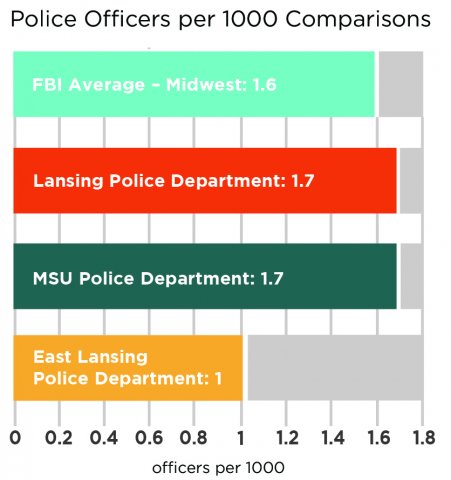
He then showed a slide from a previous presentation, showing the recommended staffing levels for a Midwestern town as recommended by the FBI, which suggests a minimum of 1.6 officers per 1000 residents. East Lansing currently has a ratio of 1 officer per 1000 residents.
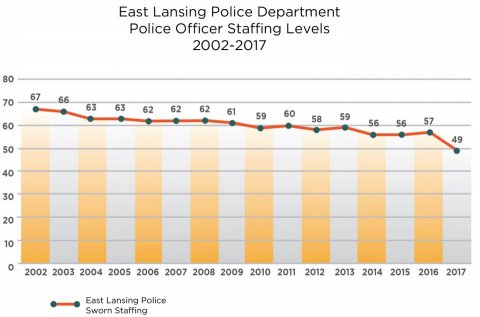
Since 2002, Sparkes explained, East Lansing has lost school resource officers, the entire traffic safety unit, and the community activities bureau, which provided outreach programs at schools and community events. He said that East Lansing is already at what he considers to be the minimum staffing level of four officers and one supervisor per shift, so if more positions are reduced, that would mean eliminating specialty positions and putting those officers back on road patrol.
East Lansing’s only remaining school resource officer, who serves at the East Lansing High School, will no longer work that role after the end of this school year if additional revenue is not secured.
Council Member Aaron Stephens asked if that position might be preserved if the school was able to pay for more of that officer’s salary (the District currently pays half). But Sparkes responded, “It’s not necessarily the money that they pay, it’s that I need that person on patrol.”
East Lansing has also been having an officer serve on a regional drug team. Because there has been an East Lansing officer on that team, ELPD has been able to bring the entire team of “twenty or more” officers into East Lansing during times when drug problems were anticipated, like St. Patrick’s Day or during the Final Four tournament. That position has already been eliminated and, as a consequence, ELPD will not be able to call on that additional help in the future.
So far this year, East Lansing has lost two Parking and Code Enforcement (PACE) positions, two police cadets, and one jail officer. There are four more positions proposed for elimination in the next fiscal year, which would result in the reduction of detective positions. Those officers would be moved to street patrol, leaving the detective bureau with only four officers. This could lead to delay in investigation of minor crimes, like thefts, according to Sparkes.
“The other thing that we can do, and it’s not a great answer,” said Sparkes, “is we could take our community safety officer and put that person back on patrol. But if we do that, then all our licensed liquor establishments downtown, the proactive patrols there, are essentially eliminated.”
He explained that “that includes random ID and compliance checks. I think those checks are important to keep our businesses safe downtown, and I would really hate to do that. But I think that’s how I would look to address it. There really aren’t a lot of great answers here.”
Council Member Erik Altmann asked Sparkes to respond to a complaint that had been raised in public comment last year, when a citizen said that ELPD often sends two cars to investigate minor problems like someone sleeping on a park bench. The person making the comment saw that as wasteful.
“It’s an unknown,” replied Sparkes (below) about that kind of call. “It could be a somebody sleeping, it could be someone who is intoxicated, it could be something much worse."

He went on: "When one officer arrives, we’ve found just through history and everything, that people [being checked on] say, ‘well maybe I could fight that person’ and you might have to go hands-on with them. If you go hands-on with someone you’ve lost,” because any escalation to violence is a bad outcome.
“Let’s prevent it,” Sparkes said, explaining why ELPD would send two officers in such a case. “You show up with two people, there’s no fight, and nobody gets hurt, and we keep the force continuum at the lowest possible level. I think that’s smart policing.”
Fire Department, including ambulance services, “operating really lean”:
Speaking to Council after Sparkes, Fire Chief Randy Talifarro reiterated the information he had previously shared on minimum staffing requirements for fighting fires in different types of structures. The standards for fighting a fire at even the simplest structure, a single family home, calls for staffing above East Lansing’s current staffing level.
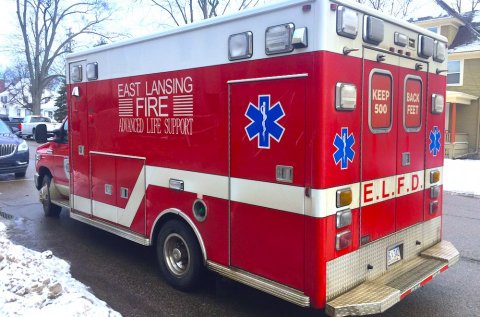
East Lansing maintains a minimum of eleven firefighters on duty for each 24-hour shift, which equates to one fire truck with a three-personnel minimum, and one ambulance with a two-personnel minimum, at each of East Lansing’s two fire stations. There is also an incident commander who must manage the scene when trucks are called out to an emergency.
“I’d say we’re operating at minimum staffing levels at least 70% of the time, if not more [often] than that,” said Talifarro (below).

There used to be a second firetruck operating out of the Abbot Road station, but that truck was lost due to budget cuts.
“We are really operating really lean,” he said. “When I look at our budget now, it’s about 90% personnel costs, so we don’t have [funds to spend on] capital equipment, we don’t have all the other things, they’ve already been eliminated from the budget.”
“We call ourselves a fire department, but I really think we need a name change. We’re really a division of emergency services,” he told Council. He explained that 70% of the runs ELFD makes are medical in nature.
ELFD also handles high-angle rescue, water rescue, hazardous material mitigation, and structural collapse. The department also has a tactical EMS unit for active-violence scenarios, like when there is an ongoing shooting and EMS workers have to try to treat wounded people in a dangerous scene.
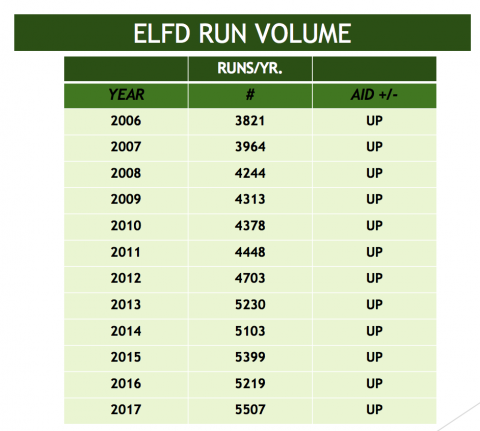
“While staffing has decreased, the work has increased,” Talifarro said. “If you look at our run volume in 2006, we were at 3,821 calls, [or] requests for service. [In] 2017, that number has gone up to 5,507. When you think about it, we had another fire truck in service and we were responding to 2,000 less calls.”
“There’s no option but to get into some of these services and yet they’re driving our run volume up considerably,” he told Council. He also pointed out that a lot of inhabited property, especially apartment buildings, has been added to ELFD’s area of responsibility due to the border-extending agreements that have given East Lansing the Northern Tier suburbs. This area used to be part of Bath Township.
The current proposed budget eliminates two positions from the ELFD, with four more projected for next year. According to Talifarro this creates a scenario where it is likely that units will be taken out of service for “brown out” periods.
“We can’t continue to do more with less. You’re going to have to do less with less,” he said.
While deciding which units to take out of service, Talifarro said that his first inclination would be to take out the firetrucks, because “they don’t generate revenue” like ambulance runs do. (Ambulance runs are often covered by patients’ medical insurance policies.)
“We could have a cascading kind of impact if you take units out of service and those units are ambulances,” he explained, “and then we lose the revenue that supports that, and [that] exacerbates the budget problem.” The EMS side of ELFD generates about $1.3 million in revenue from billing for ambulance runs.
He said using run data to decide when to brown-out units could have an unforeseen side effect, since there are more fires during the day but that fires at night, which happen while people are sleeping, tend to be larger, harder to fight, and more deadly. He also explained that it isn’t necessarily a good idea to cut overtime since “a lot of those runs generate revenue.”
Facing a major financial crisis, East Lansing’s City Council has taken an increasingly aggressive approach to cutting the budget, with some cuts in the current fiscal year and additional projected cuts that will take effect if additional revenue streams are not secured. There will be a series of public hearings at City Council next Tuesday, May 9, to discuss which of nine revenue proposals will be voted on by East Lansing citizens.
eastlansinginfo.org © 2013-2020 East Lansing Info