
You are on eastlansinginfo.org, ELi's old domain, which is now an archive of news (as of early April, 2020). If you are looking for the latest news, go to eastlansinginfo.news and update your bookmarks accordingly!
You are on eastlansinginfo.org, ELi's old domain, which is now an archive of news (as of early April, 2020). If you are looking for the latest news, go to eastlansinginfo.news and update your bookmarks accordingly!

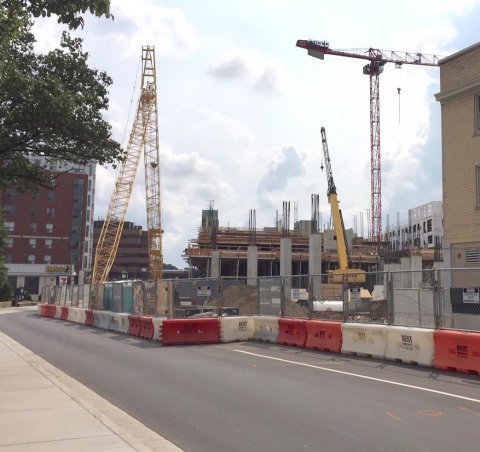
Above: A sign recently added to the construction area downtown.
In response to concerns raised by downtown business owners about construction driving customers away, East Lansing’s City Council is looking for new ways to send the message that “East Lansing is Open for Business.”
Two members of Council—Aaron Stephens and Shanna Draheim—argued at last week’s discussion-only Council meeting for expanding free parking downtown during construction. As they remain in the minority, this appears unlikely to happen.
For his part, Mayor Pro Tem Erik Altmann expressed skepticism that businesses have really been experiencing a downturn.
Functioning as Mayor while Mark Meadows is away on vacation, Mayor Pro Tem Erik Altmann asked, “Do we have any independent way to assess the amount of lost business associated with this construction? Because the places I go downtown are pretty full, the festivals downtown are pretty full. So I guess I question some of the assumptions here that we are talking about. How much of a problem is this really?”
He asked if there was any way to assess whether there’s really been a downtown. Tom Fehrenbach, East Lansing’s Community and Economic Development Administrator, responded that he did not know of an objective way to verify business losses.
Altmann continued, “In other construction zones have they tried to measure it? And if they have and if there has been a loss of business associated with that who bares the cost for that?”
The City’s Planning, Building & Development Director, Tim Dempsey, responded that he wasn’t aware of any situation where communities had compensated businesses for loss during construction projects.
City Manager George Lahanas does seem to believe downtown businesses are suffering losses from construction. He told Council last week that he has presented business owners’ concerns to the Downtown Development Authority (DDA) with the message that the City and the DDA need “to spend more money, to focus more money on marketing to help our downtown businesses.”
Pat Riley, owner of Harper’s Restaurant on Albert Avenue and P.T. O’Malley’s bar on Abbot Road, was back at the microphone during last week’s discussion meeting to emphasize the points that he had previously raised to Council about downtown businesses suffering during construction of the Center City District project.
This past week, Riley was particularly concerned about possible street closures on Abbot Road. He said that disruption to traffic on Abbot would “land lock” some local businesses, and suggested in response they could sue the City. He also requested that the Department of Public Works (DPW) look at the detour signs that are up downtown to make sure that they are not misleading motorists. Riley objected to “road closed” signs when there are no roads closed.
According to Dempsey, there are no construction containment plans that would fully close off Abbot Road. He said that if the DRW/Convexity project does happen, Abbot Road will only be closed while it is resurfaced, a very short span of time.
Albert Avenue, however, is a different story.
According to the construction containment plan for the Center City District project, to which Mayor Mark Meadows agreed on behalf of the City, Albert Avenue is unlikely to fully reopen until the project is nearly done, which is expected to take at least another year. The Center City developers are paying the City a total of $26,440 for use of Albert Avenue (shown below) and the east-west alley between Abbot Road and M.A.C. Avenue for about two years’ use for construction staging.
Riley also went on to say that the downtown businesses are unable to put as much money into marketing as is needed to overcome the public’s perception that the downtown area is impassable due to construction. He said that even if a coalition of business owners were to try to organize a coordinated campaign, there would be some businesses who were unable or unwilling to pitch in.
Instead, Riley suggested, developers should commit $10,000 per month to an advertising campaign to promote downtown businesses while construction is underway.
Council Member Shanna Draheim called the $10,000 per month suggested figure “pretty steep,” but agreed that requiring a commitment to contribute to marketing efforts would be a good idea for future development agreements.
The East Lansing Buzz campaign, costing $40,000 and featuring a bee in a construction worker’s helmet, was funded by joint contributions from the Center City development team and from the Downtown Development Authority. (The developers’ half is being reimbursed out of the public bond.)
But Riley denounced what he considers to be the waste of $40,000 on the “EL Buzz” campaign, saying it was ineffective. Dempsey countered that the campaign had involved hiring a downtown East Lansing PR firm, Publicom, and that that company had won a national award for the campaign.
Council Member Aaron Stephens suggested that businesses in the area impacted by construction should receive additional free parking vouchers to distribute to their customers—as many as needed in order to offer effectively free parking to patrons of downtown businesses.
Draheim agreed with Stephens, saying, “we should make sure that every resident and every visitor knows…if you’re spending money downtown, if you’re shopping or dining or doing business downtown, [you get] free parking.” Draheim and Stephens were willing to see the free-parking voucher program expanded around the downtown, to get people parking and walking around downtown, saying the money would be well spent.
There are currently 54 businesses considered to be in the immediate construction zone that can receive $100 in free-parking vouchers from the City during construction. According to Dempsey, only half of the eligible businesses are picking up these free-parking vouchers. Of the vouchers that are being distributed to businesses, only about 52% are being redeemed.
After the meeting, I contacted Meg Croft, owner of the downtown craft business Woven Art, to ask about her experience with the vouchers. She said that her business is giving out all $100 worth of parking vouchers per month, and then purchasing additional vouchers to distribute to her customers after those run out. Croft told me she uses up the City-issued parking vouchers within 7-10 days, since most of her customers park in municipal ramps and she passes them out with every purchase.
At the meeting last week, Council Member Ruth Beier suggested delivering the vouchers directly to the 54 eligible businesses instead of waiting for them to come and pick them up. Beier also supported a close look at signage for problematic messages. She suggested that better signage is in order, to give a clear message that businesses are accessible.
Lahanas said that he will be moving forward with efforts to increase traffic to downtown businesses. Fehrenbach said that, given limited funds, City staff’s goal was to undertake “low cost, high visibility” efforts “and those that would be measurable.” He said staff prefers social media messaging, because these are low cost and produce statistics about the number of “impressions” produced on platforms like Twitter and Facebook.
You may also be interested in:
Planning Director Suggests City Has Overbuilt Parking Ramps
ELi’s comprehensive coverage of the Center City District project
Site Plan Approved for Vacant Corner – But Uncertainty Remains
Why So Much Vacant Retail Downtown?
Alice Dreger contributed reporting to this article.
Disclosure: Meg Croft serves on ELi’s Community Advisory Board, and ELi has been sponsored by various downtown business owners, including through the Responsible Hospitality Council. See our sponsors here.
eastlansinginfo.org © 2013-2020 East Lansing Info