
You are on eastlansinginfo.org, ELi's old domain, which is now an archive of news (as of early April, 2020). If you are looking for the latest news, go to eastlansinginfo.news and update your bookmarks accordingly!
You are on eastlansinginfo.org, ELi's old domain, which is now an archive of news (as of early April, 2020). If you are looking for the latest news, go to eastlansinginfo.news and update your bookmarks accordingly!
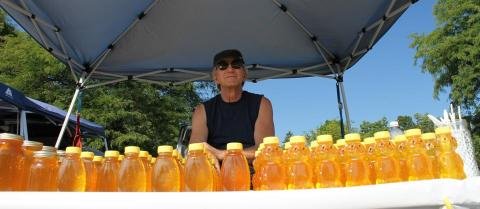
The East Lansing Farmers' Market has been featuring a product I've never had before, but I've become addicted to: dark honey, produced as a byproduct of processing beeswax. Beekeeper Dale Woods runs Applegarth Honey. Slogan: "we serve the queen." He appears weekly on Sundays, 10 am - 2 pm, in Valley Court Park.
Woods' operation is located in Fowlerville, Michigan, and he has sold his wares at many of the markets in the area, including Allen Street, Merdian, Mason, Chelsea, and the take-your-life-in-your-own-hands drive-through farmers' market of St. John's. He offers traditional light honey that tastes buttery and fresh, as well as the darker variety that tastes to me more rough and wild. I use it on my granola and in my tea.
Woods explained to me how the dark honey is produced. The honey in the combs is covered with a thin coat of wax. The beekeeper cuts the surface layer of the wax off to get the honey out. If he heats that capping, he'll get beeswax floating to the surface of the heated vessel. At the bottom of the heated vessel rests a dark layer of honey.
Woods says that most beekeepers treat the dark honey almost like it is waste, sometimes selling it to hunters for traps. He used to give it to his brother, until he realized people like it so much they'd pay good money for it. Now his brother gets the light honey. When I was at the market one week, Woods had only one jar of the dark honey left by 1 o'clock.
Woods also offers a variety of beeswax candles. Many people prefer beeswax candles because they give off very little smoke and last a long time.
Woods maintains about forty hives, and his beehives generally stay put on his land. (Once in a while he will help out a farm.) When his bees head out, they feed mostly on the local wildflowers. Woods explained that, although you'll see marketers claiming that their honey is made from some particular type of flower, in fact, unless you're going to strap a camera to the top of every bee, you can't really know precisely what it is they're feeding on.
Generally a honey marketed as being from a certain flower is really just labeled according to what it tastes like the bees probably farmed. You'll see "clover honey," but there really isn't enough clover out there nowadays to account for all that clover honey. It's just called that because it tastes like what people think "clover honey" tastes like.
Woods can't remember how long he's been beekeeping. He says his daughter has calculated it out at about 35 years. When last I spoke to him, his hives had not been effected by Colony Collapse Disorder. Woods told me that stationery beekeepers like him have generally been much less affected. The malady is mostly effecting commercial pollinators.
If you'd like to taste some of Woods' honey for free, head down to the East Lansing Farmers' Market next Sunday, 10 am - 2 pm. Look for the guy in sunglasses with lots of jars of honey.
Also check out ELi's report on local pollinators.
The East Lansing Farmers’ Market is open Sundays from 10 am to 2 pm in Valley Court, rain or shine. You can read about other vendors in our weekly Market Monitor.
This article originally ran on July 14, 2015.
eastlansinginfo.org © 2013-2020 East Lansing Info