
You are on eastlansinginfo.org, ELi's old domain, which is now an archive of news (as of early April, 2020). If you are looking for the latest news, go to eastlansinginfo.news and update your bookmarks accordingly!
You are on eastlansinginfo.org, ELi's old domain, which is now an archive of news (as of early April, 2020). If you are looking for the latest news, go to eastlansinginfo.news and update your bookmarks accordingly!
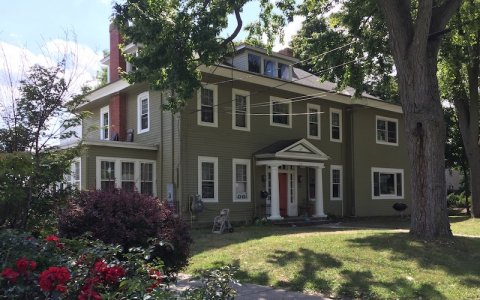
Above The Phoenix Co-Op in the Oakwood Historic District in a photo from Summer 2019.
A decision on the boundary changes to the Oakwood Historic District is likely to wait until February to give East Lansing staff time to prepare legal paperwork for each of the several options.
“It’s not called kicking the can if you don’t have the data,” argued Mayor Ruth Beier at the Council’s discussion-only meeting Tuesday night.
The East Lansing City Council appeared to lean towards approving a new recommendation from the city’s Historic District Commission, which would limit property removals to the southeast corner of the district, where the City is trying to redevelop property owned by the Downtown Development Authority.
But the paperwork for that option would have to be drafted by the city attorney for a modified ordinance after a vote, instead of being a clearly defined option before the Council like others that are being considered. By delaying it until Feb. 11, City staff will have time to draft an Ordinance 1446c, which follows the recommendations of the Historic District Commission.
Director of Planning Tom Fehrenbach said the City already had a problem with the existing legal definition of the district not matching the actual district. “I think you’ll want to pass an ordinance that has the legal designation you want," he said.

Several people who own or manage properties along Oakhill Avenue, including homeowner Sante Perrelli (above) and members and staff of the student co-op system, testified in favor of being taken out of the district, as outlined in draft Ordinance 1446b.
Bryan Moody (below), Vice President of Facilities for and a resident of the Phoenix Co-Op on Oakhill Ave., said the high cost of repairs to the historic facade of the 1915 building, under historic district rules, prevented the affordable student housing organization from making other repairs.

They found a sympathetic audience in Beier and Council Member Mark Meadows, who continued to favor a more aggressive reduction in the historic district to free property owners south of Oakhill Avenue where properties either had lost their historic character or been razed and redeveloped into newer residences.
“We had pretty strong statements from the property owners that they don’t want to be in,” Meadows said.
But Council Member Jessy Gregg insisted on keeping changes limited to the problem at hand -- increasing the redevelopment potential to the DDA properties along Evergreen Avenue.
“It’s my perception that the reason we opened up the historic district process in the first place was the Evergreen properties,” she said. “We should take the solution that most closely mirrors the problem, and that’s this one,” referring to the Historic District Commission recommendation.
Gregg agreed with the HDC that taking out individual properties could undermine the integrity of the historic district. She said it would lead to a situation where property owners would ask to be given the same treatment as those on Oakhill asking to be removed. “It opens up this idea that you can opt in and out of the district. People who purchased property in the historic district knew it was an historic district and signed onto it.”
The Council dealt with the Evergreen properties later in the meeting Tuesday night, dismissing a suggestion from Council Member Lisa Babcock to pay for an appraisal on the properties, which the DDA purchased years ago and will likely sell at a loss.
Below: Jessy Gregg and Lisa Babcock.

Even at $6,000 for the appraisal, Gregg said it would simply be throwing good money after bad, and the City should start its negotiation for the redevelopment of those properties from previous bids, which came in at $3 million and $5.5 million.
Mayor Pro Tem Aaron Stephens and Beier agreed with her position. “We know our bottom line,” Beier said.
In the contrasting position, Babcock said the lack of a professional appraisal would let prospective buyers have more information than the City, giving them the upper hand.
Photos from the City Council meeting by Raymond Holt.
eastlansinginfo.org © 2013-2020 East Lansing Info